
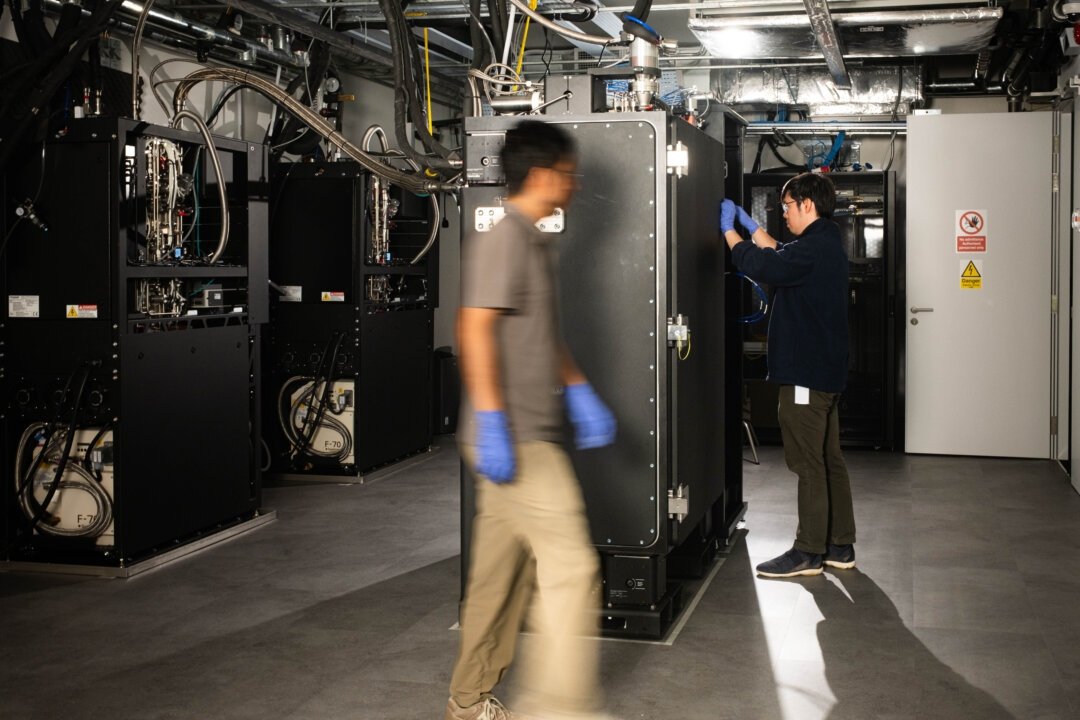
David Carvalho, CEO of Naoris Protocol, said encrypted data is being harvested around the world ‘waiting for quantum computers to crack it open tomorrow.’
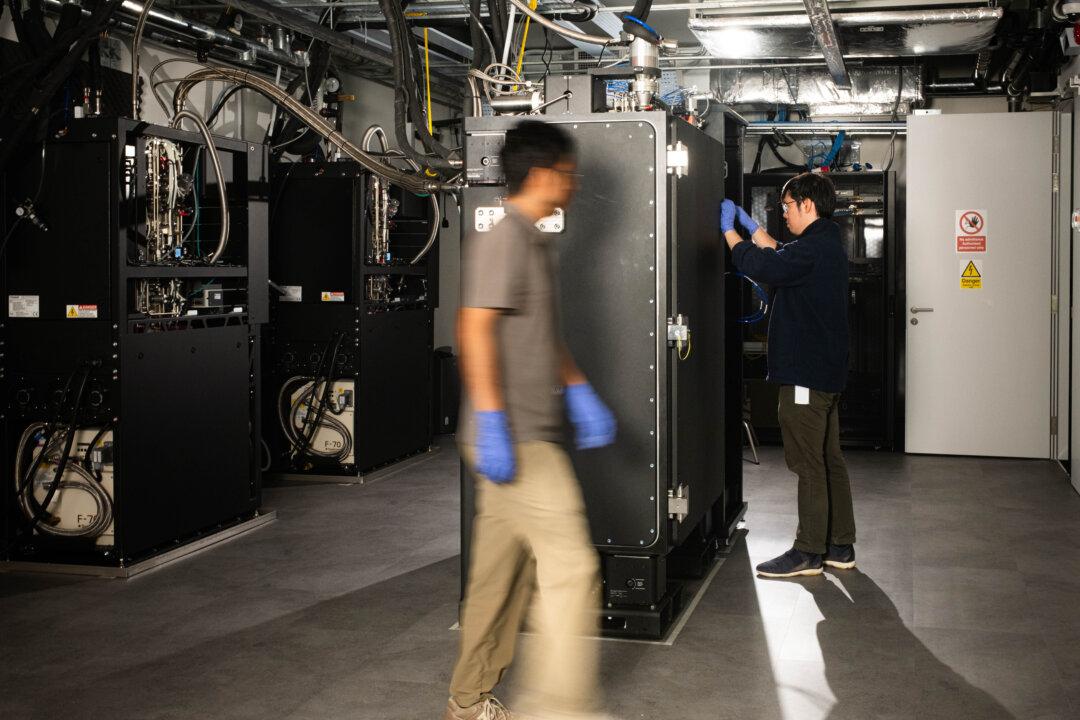
Google Quantum AI, part of California-based technology giant Alphabet Inc., announced on Dec. 9, 2024, that it had invented a quantum chip called Willow that was able to make calculations in a fraction of the time it would take a traditional supercomputer.
Hartmut Neven, the founder and lead of Google Quantum AI, said a quantum computer could benefit humanity “by advancing scientific discovery, developing helpful applications, and tackling some of society’s greatest challenges.”
In March 2025, researchers in China announced they had created a quantum computer, Zuchongzhi 3.0, which had the same computational power as the Willow chip.
Experts say quantum computing could be enormously beneficial to society, but it could also allow nation-states and nefarious actors to break the encryption surrounding bank accounts, medical records, military secrets, and cryptocurrency.
“All secrets basically have a shelf life,” David Carvalho, founder and CEO of Naoris Protocol, the world’s first decentralized cybersecurity mesh powered by a post-quantum blockchain, told The Epoch Times.
He said nation states are storing a lot of encrypted data, and it is flowing across the internet, and it would be vulnerable on what is known in the industry as Q-Day, the moment that a quantum computer can finally break encryption.
Data Harvested for Q-Day
Carvalho said this encrypted data is being harvested by nation-states and hostile actors, “waiting for quantum computers to crack it open tomorrow.”
Q-Day could happen in the next 10 to 14 years, Daniel Burrus, San Diego-based futurist and bestselling author, told The Epoch Times.
But quantum computers are sensitive to errors, which limit the level of complexity they can handle, said Burrus. He said the designers building them are working on fault-tolerance systems, which would iron out those errors as the qubit size of the computer increases.
Burrus predicted that fault-tolerant computers would come online between 2030 and 2035, but on an insufficient scale to have a major effect. However, he said, “Going up to 2040, that’s where you could have large-scale problems with legacy crypto systems.”
Google’s Willow chip and China’s Zuchongzhi 3.0 each have a calculating power of 105 qubits (units of quantum information), but in order to break the type of encryption used to protect bank accounts, medical records, military secrets, and blockchains, a quantum computer would need to have several million qubits.
An academic paper published in 2022 by researchers at the University of Sussex in England found that a quantum computer composed of 13 million physical qubits could break Bitcoin encryption within a day, and one with 317 million qubits could do it within an hour.
“Our estimated requirement of 13–300 million physical qubits suggests Bitcoin should be considered safe from a quantum attack for now,” Mark Webber, the paper’s lead author, said at the time. “But quantum computing technologies are scaling quickly with regular breakthroughs affecting such estimates and making them a very possible scenario within the next 10 years.”
In a blog, Neven said, “Willow performed a standard benchmark computation in under five minutes that would take one of today’s fastest supercomputers 10 septillion (that is, 10 to the power of 25) years—a number that vastly exceeds the age of the universe.”
But Ciaran Hickey, assistant professor in the School of Physics at University College Dublin in Ireland, told the podcast Futureproof, “It’s not in any way a useful calculation.”
“It was purely created and designed just to benchmark quantum computers,” Hickey said. “Can it do other calculations equally fast? The answer unfortunately is no, not yet.”
He said that, theoretically, a quantum computer could be used in the future to break encryption.
“Currently, if you make a transaction on a bank account, some of that data is encrypted, and a quantum computer could in principle break that encryption very easily,” Hickey told the podcast.
In recent months, additional advances in quantum computing have been announced.
In November, Quantinuum unveiled Helios, which it said was the world’s “most accurate quantum computer.” In December, Horizon Quantum Computing announced it had completed the assembly of a quantum computer at its headquarters in Singapore.
IBM has also announced progress with its Nighthawk quantum computer, and said on Nov. 12 that it is on schedule to produce “fault-tolerant quantum computing by 2029.”
Burrus said he sees the world in terms of “hard trends”—something that will happen—and “soft trends,” which may or may not come to pass.
He said a quantum computer with massive powers of calculation is a hard trend.
“The value of a hard trend is you can see disruption before it disrupts, and you can see problems before you have them,” he said.
Post-Quantum Cryptography
Burrus said that’s why there are many companies working on post-quantum cryptography (PQC), which would add a layer of protection that could combat a quantum computer.
“The good news is we can develop the software while the hardware is still being developed,” said Burrus, adding that PQC is a “mitigation strategy” for Q-Day.
The U.S. Department of Homeland Security has published a roadmap that estimates that a “cryptographically relevant quantum computer” could be available by 2030.
In May 2022, the White House published a national security memorandum, NSM-10, which stated that agencies must prepare now to implement PQC due to the threat posed by potential future quantum computers.
In November 2022, the White House sent a memo to the chiefs of all federal agencies and executive departments, outlining the importance of preparing for Q-Day.
Cryptocurrencies are especially vulnerable to quantum computing.
“The uncomfortable truth is that every blockchain is vulnerable to elliptic-curve cryptography in the context of quantum,” said Carvalho. “The first quantum attacker will lead first, so whenever that happens, they will have access to potentially all of them, especially the ones that have been exposed or the ones that have ever had any transaction.”
Terminator Scenario
Scientist Paul Benioff first predicted the invention of quantum computers in the early 1980s, and in 1984, Hollywood movie “The Terminator” came out. The movie is set in a dystopian future in which an incredibly powerful computer called Skynet develops self-awareness and goes to war with mankind.
Carvalho said if people do not build quantum resistance into their projects, processes, infrastructures, and data now, it could be too late.
“It’s encrypted, but very soon it will be decrypted, and the keys that are around it will be available,” said Carvalho, who compared it to the plot of “The Terminator” films in which Arnold Schwarzenegger’s character is sent back to the past to change the future.
“It’s a similar situation. For you to save your future, you need to be quantum resilient now, because the future quantum capability is going to reveal your past keys that are your future and your past and your present,” he said.
But Carvalho said regulators in the United States and the European Union are growing increasingly aware of the threat from quantum computers.
“There are mandates for any critical infrastructure environments that deal with the government, military contractors, et cetera, to be quantum-resilient before 2030, and in some cases, 2028. So we’re in 2026 now. It’s not a lot of time,” he said.
“We have to make sure that we’ve got human oversight in all the things we’re doing, so that we don’t create a Terminator-type world, which is technically possible.”