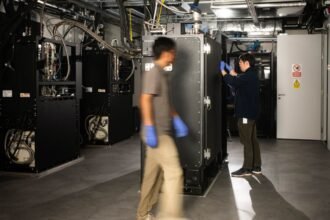
IT investment now accounts for the largest share of US economic output since 2001, according to IMF economists.

The International Monetary Fund (IMF) raised its outlook for U.S. economic growth in 2026, citing a surge in investment in artificial intelligence (AI) infrastructure.
In its January update, the IMF said it now expects the U.S. economy to grow by 2.4 percent in 2026, up from about 2.1 percent projected in its October 2025 World Economic Outlook.
The fund trimmed its 2027 forecast slightly, edging it down by one-tenth of a percentage point, to 2 percent.
The upward revision for 2026 is driven in part by heavy spending on data centers, advanced semiconductors, and power infrastructure needed to support AI systems, the IMF said.
“While manufacturing activity remains subdued, IT investment as a share of US economic output has surged to the highest level since 2001, providing a major boost to overall business investment and activity,” IMF Chief Economist Pierre-Olivier Gourinchas and Financial Counselor Tobias Adrian said in a Jan. 19 blog post.
Although the AI-led investment boom has been concentrated in the United States, the IMF said it is also producing spillovers abroad, particularly by supporting Asia’s technology exports.
US Growth
U.S. growth accelerated to an annualized 4.3 percent pace through much of 2025. The boost helped offset the drag from a 43-day federal government shutdown that began in October 2025 and weighed on activity in the fourth quarter before a rebound in early 2026, the fund said.
AI-related capital expenditures contributed 1.1 percentage points to gross domestic product (GDP) growth in the first half of 2025, according to figures from JPMorgan released on Dec. 9, 2025.
Tech-related categories contributed 4.3 percentage points to overall investment growth, offsetting declines elsewhere, the bank said. Hardware led the surge, with investment in computers and related equipment up 41 percent from a year earlier, reflecting strong demand for servers and graphics processing unit systems.
The bank said the investment boom has been driven by large technology “hyperscalers,” including Meta, Alphabet, Microsoft, Amazon, and Oracle, which are projected to allocate a combined $342 billion to capital spending in 2025, a 62 percent increase from the previous year.
Private firms such as OpenAI and Anthropic are also investing heavily to support advanced AI model development.
JPMorgan said that from a GDP perspective, the overall impact of AI investment remains modest but is likely to grow. Official data mainly capture early spending on chips, servers, and networking gear.
Another phase, focused on power plants and grid upgrades, is beginning but will take years to show up fully in the data, the bank said.
Global inflation has been largely steady, the IMF said, with headline and core rates flat and in some cases slightly lower than expected.
In the United States, however, the high cost of living remains the most important concern cited in household surveys, the fund said. One-year-ahead inflation expectations are still elevated, and input prices reported in manufacturing purchasing managers’ indexes remain high, helping explain the Federal Reserve’s cautious stance.
Despite those pressures, the fund said that U.S. growth in 2026 will be supported by fiscal policy, a lower policy rate, and the gradual waning of the impact from higher trade barriers.
The IMF stated that it expects U.S. growth to remain solid at 2.0 percent in 2027. A near-term fiscal boost from tax incentives for corporate investment under the One Big Beautiful Bill Act of 2025 is expected to support activity, the fund said.
Technology-driven momentum is forecast to cool but will still offset headwinds from lower immigration and moderating consumer spending, according to the IMF. It cautioned that the durability of the AI boom will be a key factor shaping the medium-term outlook for both the United States and the global economy.
Global Growth
On the global stage, economic growth continues to show “notable resilience,” according to the IMF, despite U.S.-led trade disruptions and elevated uncertainty.
Global growth is projected to hold steady at 3.3 percent in 2026, an upward revision of 0.2 percentage points from October 2025 estimates; most of the improvement is accounted for by the United States and China, according to the IMF.
Projections are broadly unchanged from a year earlier, suggesting that the global economy has shaken off the immediate impact of recent tariff shocks, the fund said.
The IMF attributed the resilience to easing trade tensions, stronger-than-expected fiscal stimulus, accommodative financial conditions, and companies’ ability to adapt supply chains. Improved policy frameworks in several emerging market economies have also played a role, it said.