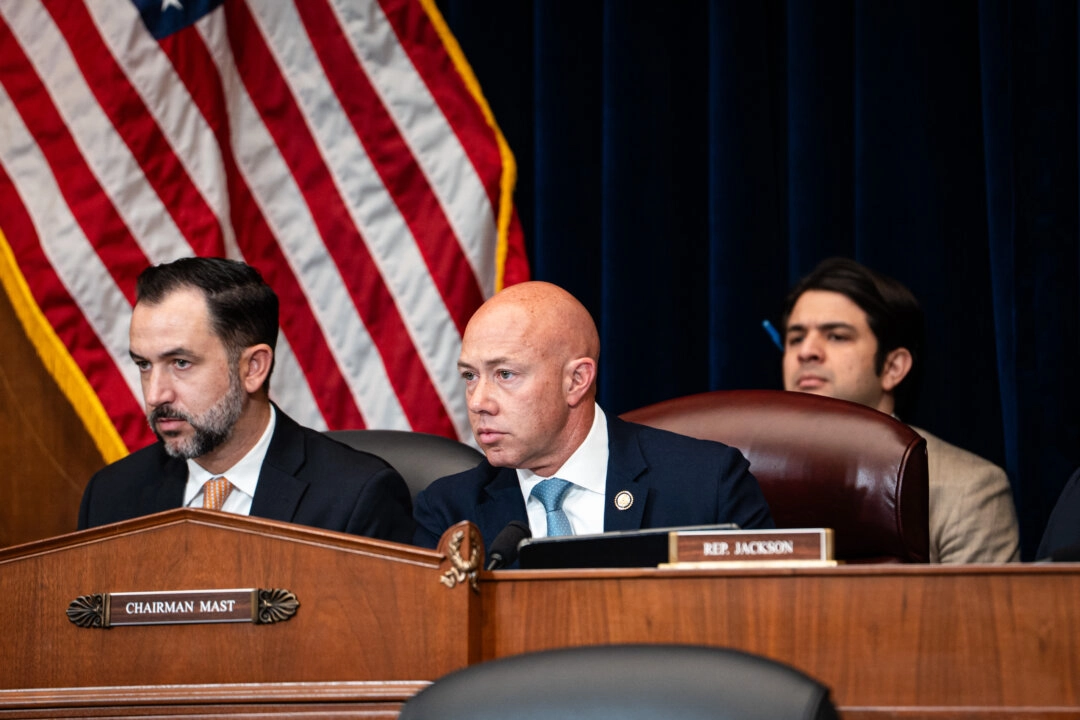
‘Advanced chips absolutely shift military advantage,’ House Foreign Affairs Committee Chairman Rep. Brian Mast said.
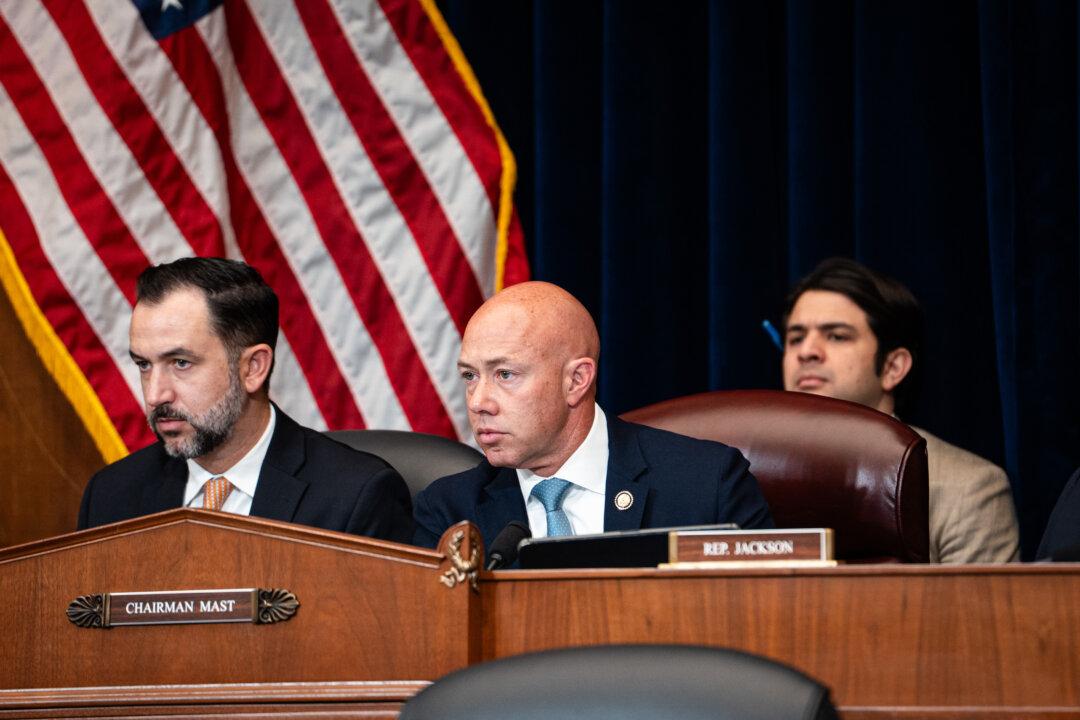
The Trump administration formalized a path for U.S. chip companies to sell more powerful artificial intelligence (AI) chips to customers in China with a new rule on Jan. 13, a day after House lawmakers celebrated the passage of a bipartisan bill aimed at closing a related export-control loophole in order to curb Chinese access to similar advanced AI chips.
On Jan. 14, lawmakers criticized the new rule during a House Foreign Affairs Committee hearing on the AI race between the United States and the Chinese regime, where several members highlighted bills that they recently introduced to support the U.S. lead in AI.
“When an export shifts America’s military advantage, Congress has a role to play. Advanced chips absolutely shift military advantage,” said the committee’s chairman, Rep. Brian Mast (R-Fla.), who introduced a bill to increase oversight of AI chip sales to countries of concern.
The new AI chip rule allows the sale of Nvidia H200 and other equally powerful AI chips to be sold to approved customers in China, with 25 percent of sales to be paid to the United States. The H200 is far more powerful than anything U.S. companies were previously allowed to sell to customers in China or anything Chinese companies can manufacture domestically. And analysts have said that the approval may erase the U.S. lead in the AI race.
Legislators on both sides of the political aisle have pushed bills to curb China’s access to advanced AI chips since Trump took office for his second term, with some bill sponsors promoting the measures as ones in line with Trump’s AI goals. Although some of those bills advanced swiftly, they may not become law even if they land on the president’s desk, as many trade penalties originally levied were halted after the U.S.–China bilateral meeting in October 2025 to secure a one-year trade truce.
The White House did not immediately respond to an inquiry from The Epoch Times.
The lawmakers heard testimony from Matt Pottinger, senior White House Asia adviser during Trump’s first term; Oren Cass, chief economist and founder of the think tank American Compass; and Jon Finer, former deputy national security adviser. Each issued grim forecasts in light of the approval of H200 chip sales to China.
“Selling Nvidia’s H200 chips to China will supercharge Beijing’s military modernization, enhancing capabilities in everything from nuclear weapons to cyberwarfare, autonomous drones, biological warfare, and intelligence and influence operations,” Pottinger said. “AI isn’t just a pivotal technology, it’s the pivotal technology that will determine whether the United States and its allies or an axis of totalitarian regimes lead in virtually all technologies, military and commercial.”
Cass similarly said that computing power—which these chips could super-boost for China—is quickly becoming “the key determinant” of a country’s technological capabilities. He described the new rule as “inexplicable,” a view most hearing participants seemed to share, as they hypothesized various scenarios and even potential misunderstandings that could have led to the dramatic policy reversal.
Finer pointed to the Chinese regime’s broken promises in Hong Kong and warned against misplaced optimism that the regime’s technological ambitions would have benign results.
Rep. Chris Smith (R-N.J.) also highlighted the human rights implications of this AI race, bringing up the Chinese regime’s use of AI to aid its mass surveillance of citizens, tracking of targets, censorship, and preemptive dissent suppression “like something from the ‘Minority Report.’”
Pottinger said AI is already being used to track people and manipulate public opinion, with TikTok serving as a “primitive example” showing the impact of recommendation algorithms assisted by AI. As AI becomes more advanced, the human rights implications will become greater, he said.
“We essentially, in pursuit of trade, sacrificed our principles on human rights three decades ago, which has put us in this difficult position vis-a-vis China,” Pottinger said. “Let’s not compound the mistake.”
Rep. Mark Takano (D-Calif.) told The Epoch Times that he was worried that the Trump administration was “being very expedient” about allowing China access to advanced AI chips with the new rule and AI deals in the Middle East, which might provide another source for China’s chip smuggling.
“I worry about the access to high, high-grade chip technology for the United States and that the Trump administration is making it easier for that to happen,” he said.
Rep. Jim Costa (D-Calif.) said the new rule should come with more enforceable restrictions.
“We’ve got to put a host of restrictions that are enforceable with this current proposal on sales of chips to China. That’s ceding a technological advantage that we already have, and China shouldn’t be rewarded because they don’t comply,” he told The Epoch Times.
The new rule requires companies to certify that they have satisfied U.S. demand for the same chips and that the chips will not be used by the Chinese military. It is not clear how or whether the government will verify company claims.
Cass said during the hearing that the Chinese regime’s civil-military fusion approach makes it impossible to prevent these chips from being used for military purposes.
“There is no world in which we somehow don’t let them use the chips for their most valuable purposes, and they don’t develop their own chips,” he said. “It’s a pretty nonsensical approach to policy.”
A spokesperson for Nvidia said that “America should always want its industry to compete for vetted and approved commercial business, supporting real jobs for real Americans.”
Eva Fu and Reuters contributed to this report.
Correction: A previous version of this article stated that Congressman Brian Mast represented the state of Michigan rather than Florida. The Epoch Times apologizes for this error.