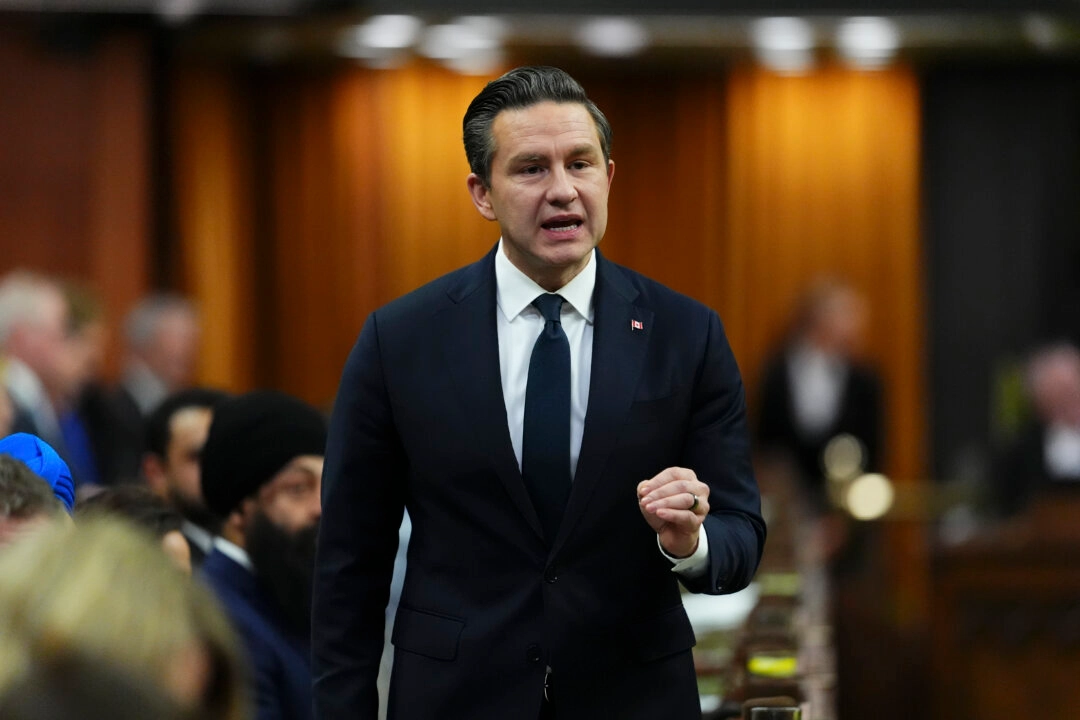

Conservative Leader Pierre Poilievre says a new deal signed by Ottawa and Beijing to reduce tariffs on Chinese Electric Vehicles (EVs) will harm Canada’s security without guaranteeing relief for farmers hit by China’s tariffs.
The federal government announced Canada will reduce its tariffs Chinese EVs from 100 percent to the “most-favoured-nation” tariff rate of 6.1 percent on 49,000 EVs per year, after Prime Minister Mark Carney met with Chinese officials in Beijing. The Prime Minister’s Office (PMO) said it expects this will “drive considerable new Chinese joint-venture investment in Canada” within three years.
Poilievre said in a Jan. 16 social media post that Carney needs to “explain how he has gone from saying China was Canada’s ‘biggest security threat’ before the election, to announcing a ’strategic partnership’ with Beijing after the election.”
“His agreement will allow 50,000 EVs onto our streets jeopardizing our security and auto jobs. This follows him breaking his promise to ‘negotiate a win’ and get a deal with the U.S. by last July,” Poilievre said.
Carney told reporters on Jan. 16 the number of Chinese EVs to be included in the tariff-rate quota will increase to reach approximately 70,000 after five years. Canada placed 100 percent tariffs on Chinese EVs in late 2024 under the Liberal government of Prime Minister Justin Trudeau.
The PMO also said it expects China will lower tariffs on Canadian canola to a combined rate of 15 percent from the current levels of roughly 85 percent “until at least the end of this year.” It also expects Canadian canola meal, lobsters, crabs, and peas will not be subject to “relevant anti-discrimination tariffs” from March 1 until the end of 2026. There was no announcement about China’s 25 percent tariff on Canadian pork. The tariffs were imposed in March 2025 in retaliation for Canadian tariffs on Chinese EVs, steel, and aluminum.
Poilievre said there is “no guarantee” China will lower or eliminate tariffs on canola and other Canadian goods, and noted tariffs on pork remain in place.
During the 2025 election campaign, Carney said China is the number one security threat to Canada. While discussing trade partners to diversify trade away from the United States, he talked about the importance of Asian markets, but singled out China, saying that China doesn’t share Canada’s values.
In recent months, his government has noticeably changed its tone on China. During his visit to the country this week he said there had been a “turning point” in the relationship between Ottawa and Beijing, while signing a number of bilateral agreements.
When asked about human rights and security concerns when it comes to dealing with China, Industry Minister Mélanie Joly, who accompanied Carney on the trip, said Ottawa is engaging with China with “eyes wide open.”